 Glens Falls Chronicle Serving the Glens Falls/Lake George region; Warren, Washington and northern Saratoga counties since 1980

By Kevin Kelly, Special to The Chronicle
Editor’s note: We first saw this article about what to plant in the green space between sidewalk and road — dubbed a “hellstrip,” for the challenges it presents — in a Warren County Cornell Cooperative Extension newsletter.
Writer Kevin Kelly granted The Chronicle permission to reprint. He is a Master Gardener with the Penn State Extension of Dauphin County in Pennsylvania. “Beauty can be found in the toughest places,” he writes. We’ve edited it lightly.
The narrow strip of land between the sidewalk and the street is often overlooked, frequently abused and rarely planted well.
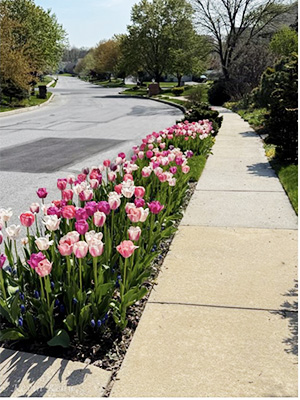
Ironically, the hellstrip is also one of the most visible planting opportunities a gardener has. Everyone walking, biking or driving past sees it.
When thoughtfully planted, it can soften hard infrastructure, support pollinators, manage stormwater and add curb appeal.
Success in the hellstrip begins with understanding its constraints — and designing within them rather than fighting against them.
Before you plant: The rules
In many municipalities, the hellstrip lies within the public right-of-way, even though homeowners are often responsible for maintenance.
A quick check with the municipal office or public works department can prevent issues later. I recommend keeping plant height below 36 inches; utilizing dwarf conifers, small shrubs, perennials, annuals and bulbs. Many governing authorities are relaxing the rules considering environmental concerns due to loss of biodiversity.
‘A garden of extremes’
Hellstrips experience conditions that differ sharply from the rest of the yard:
- Soil compaction from foot traffic and construction equipment
- Low organic matter
- Heat stress from adjacent pavement
- Inconsistent moisture, being wet in the winter and dry in the summer
- Road salts and animal urine
Creating healthy soil is key before you plant. Consider initial aeration to break up the compaction, then follow with compost annually until soil structure returns.
Light can be deceptive
Buildings, street trees, parked cars and seasonal sun angles can significantly alter available light. Observing the site over a full day — and across seasons — ensures plant choices align with reality. Here is a guide to help with plant choices:
- Full sun: 6 or more hours of direct sun
- Part sun: 4–6 hours
- Part shade: 2–4 hours
- hade: less than 2 hours
Snow, road salts, animal urine
Snow load can break stems and compress plants. Road salts and animal urine can damage plants by disrupting plant chemistry and nutrient availability. Some trial and error will be needed, but herbaceous perennials, annuals and bulbs generally do well. Small deciduous shrubs with flexible stems will tolerate the space. I have found that dwarf Chamaecyparis obtusa (Hinoki cypress) is an evergreen that performs admirably.
Design considerations
- Repetition is key: it will pull the eye along the hellstrip
- Plant densely: This is a show area. Dense planting hides some plants that may struggle
- Add annuals: To fill in gaps as needed
- Cues for care: Shorter plants along the sidewalk; keep them neat
- Vary plant height: don’t build a wall
- Keep plants below 36 inches tall; protect visibility
Perennials & annuals, both
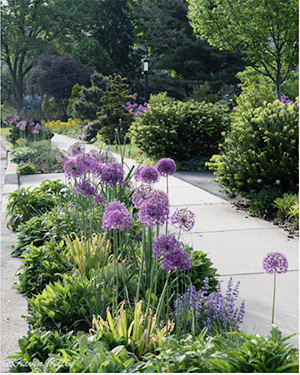
I also enjoy planting annuals in sections of my hellstrip. This can be more labor intensive, but it allows me to change the plant textures and color schemes each year. I often start these areas with tulips, then remove them and plant annuals in their place.
I will often plant textural plants like Kale or Swiss chard amongst the flowers for additional interest.
The payoff!
A well-planted hellstrip does more than solve a problem. It filters stormwater, moderates pavement heat, supports insects and quietly improves neighborhood character. It encourages neighbors to stop and chat.
Copyright © 2026 Lone Oak Publishing Co., Inc. All Rights Reserve
