 Glens Falls Chronicle Serving the Glens Falls/Lake George region; Warren, Washington and northern Saratoga counties since 1980

By Cathy DeDe, Chronicle Managing Editor
The Chronicle reached out to the Warren County Soil and Water Department to ask which are the most imperiled trees in our region.
District Technician Thresa Hajos filled us in.
Ash: ‘Decimated’
“I’d definitely say that the ash is probably number one,” she says. “More than just threatened” by the Emerald Ash Borer — an invasive golden-green metallic beetle from Asia — “most of them are dead or dying,” she says of local ash trees. “I don’t know if there’s any research of them coming back yet.”
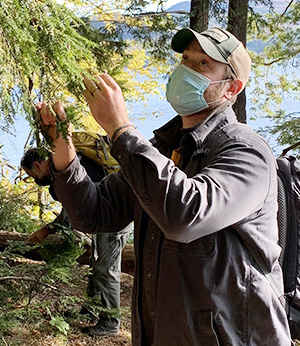
Checking for the presence of the invasive insect woolly adelgid. This Chronicle photo was taken on Oct. 8, 2020 — the day the adelgid was found there. Hemlocks on Dome Island and other places on Lake George are being treated with apparent success. The adelgid can be combated.
The first Emerald Ash Borer was confirmed in Warren County in 2020, just six years ago, she says.
Once trees are infected, “they’ll die within two to four years,” she said. “It’s definitely decimating whole areas.
“I don’t know if there’s something that will come in to replace them yet, but I’m sure something will.”
“Eradication is not an option,” says the Invasive Species of the Adirondacks website. Recommended: Reduce transportation of infested ash nursery stock, firewood, unprocessed ash logs, and other ash products to slow the spread.
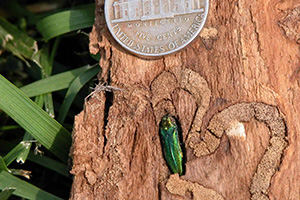
Ash represents about 7% of all trees in New York State, “with a smaller percentage in the Adirondacks,” Ms. Hajos said, quoting DEC reports.
What happens to the Emerald Ash Borer if there are no more ash trees? Will it move to another variety tree?
“Most likely, they’ll keep moving north,” Ms. Hajos says.
“EAB was first discovered near Detroit in 2002 and has spread to 13 states and two Canadian provinces. So, it’ll just keep moving.
“It’s similar to the Spotted Lanternfly, out in the Finger Lakes. They’ll just keep moving until they find a food source.”
Hemlock, next
After ash, “for forest trees, Hemlocks are going to be the next big one,” Ms. Hajos says. “Hemlock Woolly Adelgid (HWA) was first discovered in New York State in 1985 and spread to the Capital Region.
“It was first found in the Lake George region in 2017” — with the first HWA confirmed on Dome Island on Lake George in 2020.
“Once infected, trees usually die within four to 10 years.”
Of all the trees currently impacted by invasives, Ms. Hajos suggests, “Hemlocks are definitely a priority.”
That’s because the majority of the Lake George watershed consists of hemlocks, she said.
“With all the brooks that run into Lake George, and most of them being trout streams, a major loss of those trees would change the ecology of the lake.
“Hemlock loss is going to change trout streams around Lake George, and then it’s going to change water quality.
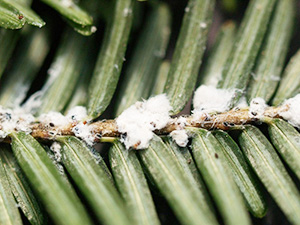
“The Lake George Hemlock coalition is working on surveying and research, and the New York State Hemlock Initiative is working on finding biological controls to mitigate the effects,” Ms. Hajos says.
Invasive species such as HWA “tend to do well,” Ms. Hajos said, because they have no native predators. “Nothing’s feeding on them.”
“The Hemlock Initiative is looking for predators they can release to feed on HWA,” she said.
With both biological and chemical efforts, “there is research showing that the Hemlocks may recover from this.”
Mike McLarty, Vice President of Forestry at Finch Paper, told The Chronicle soon after the invasive HWA was discovered in significant numbers on Lake George in 2020, that Hemlock makes up about “45 percent of our intake of wood fiber.”
He said at the time, “It’s something that concerns us,” but “We feel we’re very well diversified. We’ll still be able to source the fiber we need.”
Beech trees, two diseases
“Beech Trees will probably be the next big one,” Ms. Hajos said, with threats from both beech leaf disease and beech bark disease.
“Beech Bark disease has been around a while. Beech leaf disease, we just found in Glens Falls last summer.”
“There’s no cure right now,” Ms. Hajos says. “Tree death within two to 10 years.
“It was first found in Warren County in July 2023, in Bolton.”
Elm trees face new threat
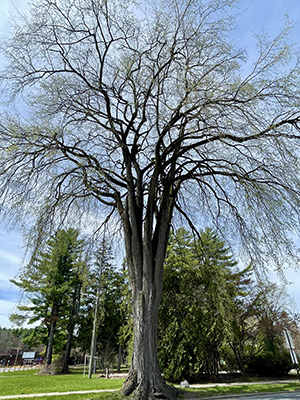
Elm trees were largely decimated in this region by Dutch Elm Disease, a fungal infection, in the mid-to-late 20th century. The disease still exists, and now, Ms. Hajos says, the remaining Elms face a new threat from the Elm Zigzag Saw Fly, confirmed in August 2022 in St. Lawrence County. It was first reported in Quebec in July of 2020, she said.
“It’s relatively new. There’s not a ton of research. That’s the case with a lot of invasives. They’re so new in the area, we’re not really seeing the impact yet.”
Red Pine Scale
Red Pines are currently threatened by Red Pine Scale, which is caused by an exotic small insect from Japan. “We’ve started noticing that more in the last few years. This is the first time that I’ve really looked on a mountainside and seen it in its full effect,” Ms. Hajos said. “October of 2024 it was found in Pharaoh Lake up north. We first saw it in Warrensburg in January 2025.”
Currently, the City of Glens Falls is harvesting a stand of Red Pine on its watershed property that is impacted by Red Pine Scale — looking to profit from the timber while it is valuable, Mayor Diana Palmer said in several public meetings
Climate issues for all
“With all trees, salt, and stress from our winters here is always a concern,” Ms. Hajos said, “and then climate issues, warming temperatures, when we have bigger rainstorms and longer droughts and harsher winters, and then more warm winters. It’s definitely changing which trees do best here.”
Quick list: 5 top trees in danger
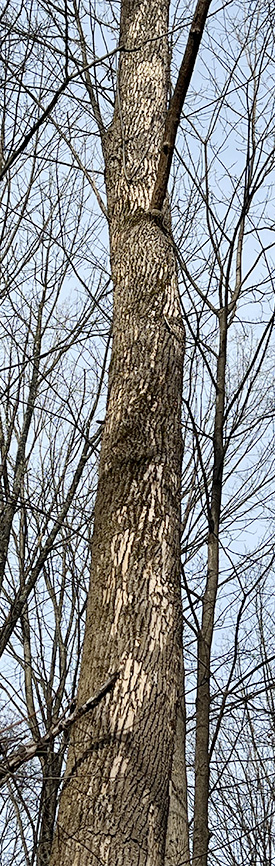
- Green Ash, native tree found in suburbs, city and forests. Threatened by Emerald Ash Borer. Usefulness of tree: Serves as a food source for wildlife, and aquatic ecosystem support.
- Eastern Hemlock, native forest species. Serves for shading streams for trout, wildlife habitat and shelter, stream bank stabilizer, filters pollutants. Threatened by Hemlock Woolly Adelgid. Keystone species, “key” to Lake George Watershed ecosystem.
- American Elm, suburb and city. Serves as a pollinator, wildlife value, shade tree, stormwater management. Threatened by Dutch Elm Disease and Elm Zigzag Sawfly. Varieties resistant to Dutch Elm Disease: Princeton, Valley Forge, Jefferson.
- American Beech, forest. Provides wildlife habitat and food source. Threatened by Beech Leaf Disease and Beech Bark Disease.
- Red Pine, forest and suburb. Soil stabilization and wildlife habitat. Threatened by Red Pine Scale and Southern Pine Beetle. Poor salt tolerance.