 Glens Falls Chronicle Serving the Glens Falls/Lake George region; Warren, Washington and northern Saratoga counties since 1980

30 volunteer dog & owner teams: ‘10,000 moments of joy’
By Cathy DeDe, Chronicle Managing Editor
While therapy dogs have long been a presence at Glens Falls Hospital, the program has grown since 2023 from a few occasional visits to a robust program with approximately 30 certified therapy dog and owner teams regularly visiting patients, visitors and staff.
“There’s nothing quite like watching someone’s expression change when a therapy dog walks down the hall or into the room, says Tom Lyons, Director of Volunteer Services, who oversees the program.
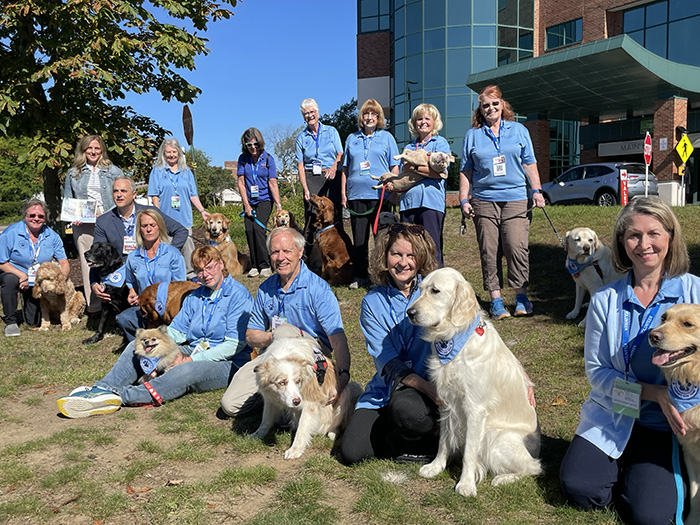
Front row: Elizabeth Strader & Beatrix, Tom Lyons & Walter, Charlene Hewlett & Cruz, Louisa Redman & Chewy, Doug Neely & Mocha, Mary DeSantis & Bryn, Sue O’Brien & Colden. Chronicle photo/Cathy DeDe
He said dogs and their owners contributed more than 900 volunteer hours this year, “nearly 3,000 hours since 2023.”
“More than hours,” Mr. Lyons says, “a team may interact with 10 or more people during a single hospital visit. We estimate that translates into more than 10,000 moments of joy, comfort and compassion each year.
“We track hours, but I think the moments behind those hours really tell the story.”
Here is some of that story, from therapy dog owners who spoke with The Chronicle.
Erin Glock’s dog Charlie, who passed away unexpectedly in July, kicked off the hospital’s push for a concentrated program. The pair were already a therapy team, and Ms. Glock says Mr. Lyons, a family friend, asked her to come aboard.
“I’ve always been involved in boards and volunteering, and it was just nice to do it with my best friend, and to see how much he could change someone’s situation,” Ms. Glock said.
“We’ve walked into rooms where people are in extreme pain, and then they see Charlie, and they completely stop. They just feel good and calm.
“We’ve had situations in the ER where we helped calm down a young adolescent who was having a mental health crisis. That was really powerful….
“We were welcomed with open arms from patients, staff, doctors, nurses, people in the offices. You’d walk onto a floor, and they’re like, ‘Oh, we really needed you today, Charlie.’ They probably need it more sometimes than the patients.
“I had stickers created,” she said, with Charlie’s image. “All the nurses and staff have them on their ID badges. We started a craze, every one (of the teams) wanting to have stickers for their personal dogs.”
Every dog gets a blue bandana with the hospital’s therapy dog logo. Owners get a “team” polo shirt. Each dog and handler has their own hospital ID badge.
Ms. Glock said that when the hospital posted about Charlie’s death, “I never realized his importance in the community. I guess it was their most viral post ever. I got so many cards and gifts, drawings from the community, from people I don’t even know. It’s a big void in my life right now, not being able to volunteer, because I did that with him.”
Glens Falls Hospital is an off-site location for Paws for Obedience, which trains therapy dog teams in Hudson Falls and Greenfield Center — now a “pipeline” for future volunteers, Mr. Lyons says.
Paws for Obedience trainer Louisa Redman is also a GFH team member with her dog Chewy.
She says not every dog can be a therapy dog. “It’s based on temperament, the dog’s willingness to want to greet people. Some dogs are born for it. Some you can train, but it’s really all up to the dog.
“There’s always a need” for more therapy dogs, she says. “There’s a lot of dogs out there with big hearts, great therapy dogs and people don’t realize it.”
After an initial assessment, Paws For Obedience offers a 12-week training, by invitation. “We teach loose leash walking, to be comfortable in situations they’re not used to, loud noises. We teach the owner to read their dog’s body language when they’ve had enough. Sometimes visits can be very stressful for dogs. Maybe somebody’s got bad news, and they’re upset. The dog feels that. It takes an emotional toll on them, too.”
Ms. Redman says, this week, “I had a woman in the hospital, sitting by herself. I said, ‘Would you like a visit with the therapy dog?’ She looked at me, and she looked at Chewy, and she started crying. She just held on to him, telling him she just got some bad news. Seeing this dog who reminded her of a dog she had years ago, it made her feel a little bit better for a minute.”
Sue McCoy, with Cricket, is a nurse who used to work at the hospital. “There are many days I could have used (a therapy dog). I wish they had this then.”
She tells a recent story from the emergency room. “There was a young child who was quite sick. His father was holding him. Cricket loves kids, so she went over. When she got ready to leave, she goes like this to his father, with the paw” — demonstrating a pat on the shoulder — “sort of like saying, It’ll be okay.”
Lois Hammond says Dash is her fourth therapy dog, but her first at Glens Falls Hospital. “My other three, they didn’t have this program. Dash loves to be petted. When somebody’s not petting him, he jumps on me, like, ‘Where’s the next person?’ You walk down a hall, staff will say, ‘Oh, here comes Dash.’ It’s very rewarding.”
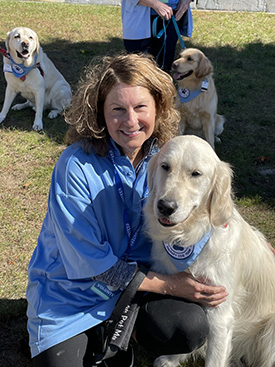
Maureen Kramer says her Otter has earned the American Kennel Club’s “Supreme Dog” title, “very prestigious,” she adds, based on more than 600 visits as a therapy dog. She tells of a non-verbal boy at the Moreau Community Center after-school program, where they also visit. “The first week he met Otter, he would sit next to him. Second week he would whisper in his ear. Third and fourth week, he would actually talk to him. It got him talking. This young man, now in school he talks to everybody.”
Doug Neely says, “Last week was kind of special,” for him and Mocha. “We had an elderly woman in one of the rooms by herself. She just loved having Mocha come up, give her kisses. She asked us if we’d stay and just talk for a while. It’s not unusual for staff members to come up and give her a hug. Last week one gave her a hug, and you could just tell it was a hard day for her. You have a lot of those moments working at the hospital.”
Retired teacher Kim Sicard, with Ellie Mae, says, “I used to have my girlfriend bring in her guide dog puppies to my classroom to learn about service dogs.” She says she wanted to train dogs too, “but I don’t want to give away my dog.” That’s what brought her to the therapy dog program.
Nancy Wade Leary started in the program with Abby to keep busy after she retired. “I go in 10 a.m. on Mondays. I’ll say we’re going to the hospital today, and oh, she knows. Her tail starts waving. She has to go say hello to everyone. If I miss a place that we usually go, she’ll stop and say, ‘Hey you missed this.’” They have a lot of regulars, she says, they get to know, nurses, or people who come the same day for treatments.
Elizabeth Strader and her dog Beatrix trained with Ms. Glock and Charlie. When it came to visiting the hospital, she said, “I don’t know if I can handle going into the patients’ rooms.” But “we started coming one day a week, and I now come four days a week. I have a different route every day, so I hit almost every part of the hospital.”
She says, she ran into a woman they’d seen in the ER a week earlier, out with family. “She’s like, ‘Oh my God, you have to meet Beatrix! This is a dog that helped me when I was in the emergency room.”
Betsy Moynehan, with Magic, says, “We all feel it’s a very great privilege to be able to visit here, and I don’t take that for granted.” She’s suffered losses at the hospital, she says. “This is the highlight of my week. We all have our own reasons for doing it, and that’s magical too.”
Mr. Lyons oversees and also participates in the program with Walter. “We’ll get stopped in the hallway: ‘Hey, could you stop by this floor, this room,’ and we’re happy to to accommodate. We have online request forms too. Sadly, when there’s a really serious incident — for example, if the emergency department team just had an extra stressful day — we’ll do a call to action to our therapy dog team, email out to the whole crew, and they’ll respond. I’ve seen almost our whole team show. We have remarkable human beings with remarkable pups. It’s a blessing to be part of it.”
Copyright © 2026 Lone Oak Publishing Co., Inc. All Rights Reserve

