 Glens Falls Chronicle Serving the Glens Falls/Lake George region; Warren, Washington and northern Saratoga counties since 1980

By Ben Westcott, Chronicle Staff Writer
After nearly 14 years as Executive Director of Lake George Park Commission Dave Wick retires this Friday.
It “seemed to be the right time,” he said, citing a desire to “let the next generation take over.”
He’s got big plans for retirement right out of the gate. In January he and his wife Kim Wick, who recently retired after 34 years as a teacher and school librarian at the Warrensburg School District, embark on a three-month globetrotting trip with stops in Hawaii, Fiji, New Zealand, Australia, Bali, Thailand, the Maldives, Dubai, Egypt, Morocco and Portugal.
Mr. Wick said he settled on the itinerary after spending hundreds of hours on his iPad researching. He intends to keep up a travel blog with updates every few days.
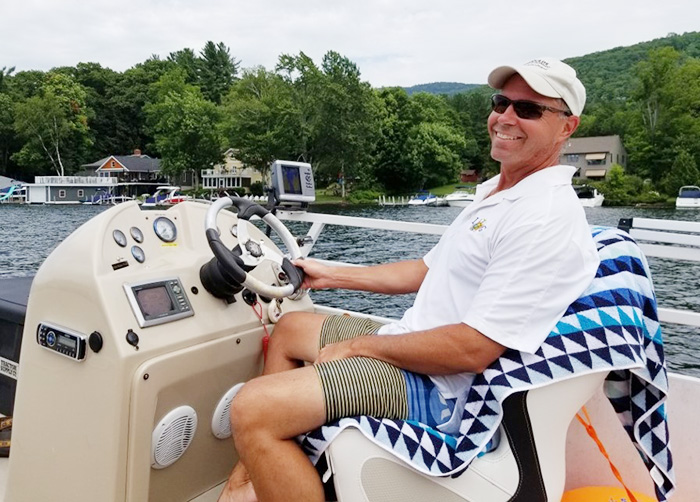
Mr. Wick said his proudest accomplishments include launching an aquatic invasive species prevention program in 2014, instituting stormwater regulations the “tightest this side of Lake Tahoe,” implementing new stream corridor regulations, inspecting over 1,000 septic systems, constructing a new LGPC building “that will last 100 years,” and increasing the LGPC’s environmental protection fund allocation from the state by 900%.
He said the LGPC’s boat inspection program “stopped hundreds of boats each year from going on Lake George with aquatic invasive species.”
Mr. Wick in his “Lake Matters” column said “the aquatic invasive species program…has kept Lake George free of new invasives for 12 years…”
He said he pushed the Park Commission to be more open and transparent and forged closer working relationships with local communities.
He said he doesn’t have any big regrets but noted the LGPC has had pushback on some programs, with people sometimes not taking kindly to new regulations.
In those scenarios he said the key has been “to prove it’s important.”
Toward the end of his tenure Mr. Wick advocated for the use of the aquatic herbicide ProcellaCOR to combat invasive Eurasian watermilfoil, a stance fought ferociously by the Lake George Association.
But the LGPC, backed by the state Department of Environmental Conservation and the Adirondack Park Agency, eventually received permission to treat two bays with ProcellaCOR in June of 2024.
Mr. Wick said invasive milfoil is now 100% gone in Sheep Meadow Bay and 95% gone in Blairs Bay, and “the native ecology is back.” He says there were “absolutely no negative environmental effects” from the application.
He said there are no current plans to use ProcellaCOR because “there is no identified need.” He said years of hand harvesting has eliminated dense milfoil beds, knocking them back to what he terms “moderate” and “sparse” beds.
“Right now we’re getting ahead of it pretty well with the hand harvesting, despite the process being costly and methodical,” Mr. Wick said.
As for the herbicide’s future use, The Lake George Mirror quotes Mr. Wick as saying, “I can’t speak for the Commissioners, but if there is the need, absolutely, ProcellaCOR should be considered a viable tool. It is safe, effective and a federal and state-approved method for treating milfoil. As the state’s entity charged with managing milfoil, the Lake George Park Commission would be abdicating its responsibilities if it simply ignored it.”
In the future, he says he’d like to see the Park Commission get more into providing money and support to communities to do environmental projects.
Mr. Wick said who his successor will be is “still up in the air,” with the final decision coming from Albany.
LGPC Deputy Director Joe Thouin will run operations in the meantime.
Copyright © 2025 Lone Oak Publishing Co., Inc. All Rights Reserved
