 Glens Falls Chronicle Serving the Glens Falls/Lake George region; Warren, Washington and northern Saratoga counties since 1980

By Cathy DeDe, Chronicle Managing Editor
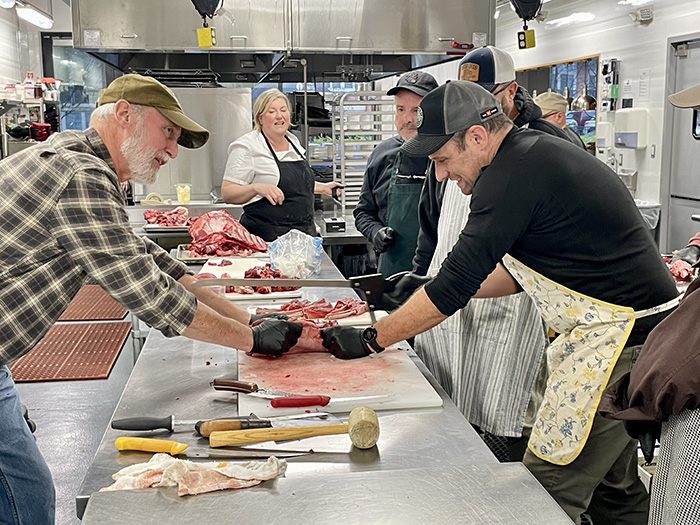
I don’t know how you spent your Sunday after Thanksgiving. I spent mine hunkered down for more than six hours at SUNY Adirondack’s Culinary Arts classroom in downtown Glens Falls learning how to butcher a deer.
Emily Peterson was our instructor in “Deer Butchery: A Nose-To-Tail Breakdown of a Whole Deer.”
Offered for the first time by SUNY Adk. Continuing Education, the cost was $115 including materials — and a book and venison to take home.
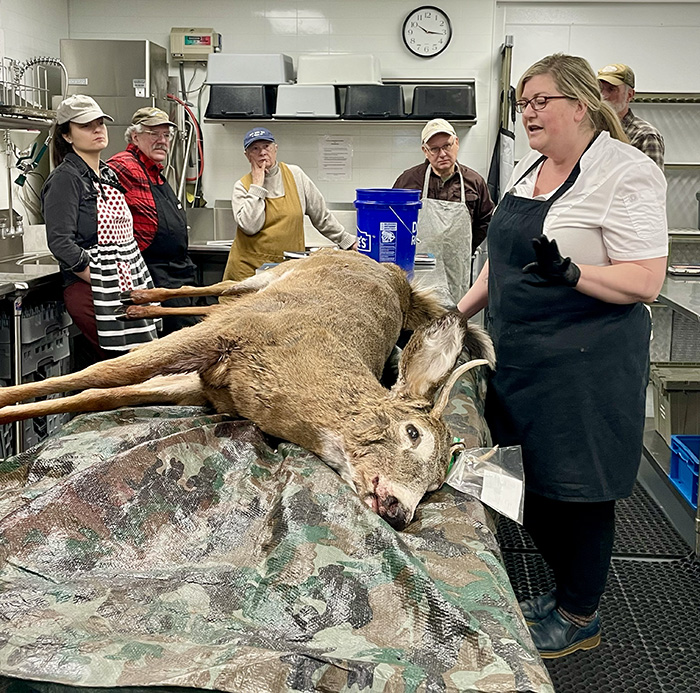
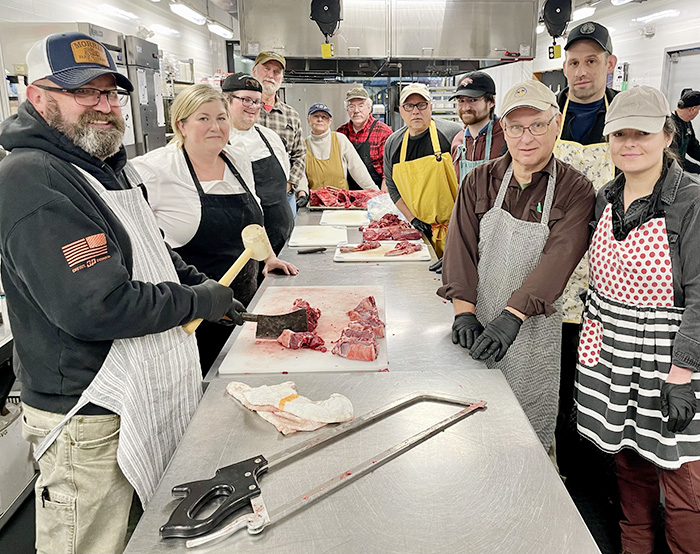
Of the 12 students — 10 men and two women — several (but not all) are hunters. Some said they’ve field dressed or even butchered their own deer, instructed by “old timers.” They wanted to learn “the right way” to do it.
A few had worked in the meat departments at Hannaford and Price Chopper, and at slaughterhouses that process deer for hunters. One mechanic turned out to be impressive with a saw.
As for me: My editor thought this might make a good story, and I was intrigued. No knives wielded by yours truly; I was there only to observe.
Emily Peterson calls herself “more a butcher,” but SUNY Adirondack calls her “Chef.” She’s been with the culinary program and Continuing Ed since 2020.
We started with a smallish buck, estimated 18 months old, with a small rack.
The deer was laid on a camouflage tarp, head to hooves, on one of the stainless steel tables in SUNY Adirondack’s teaching kitchen.
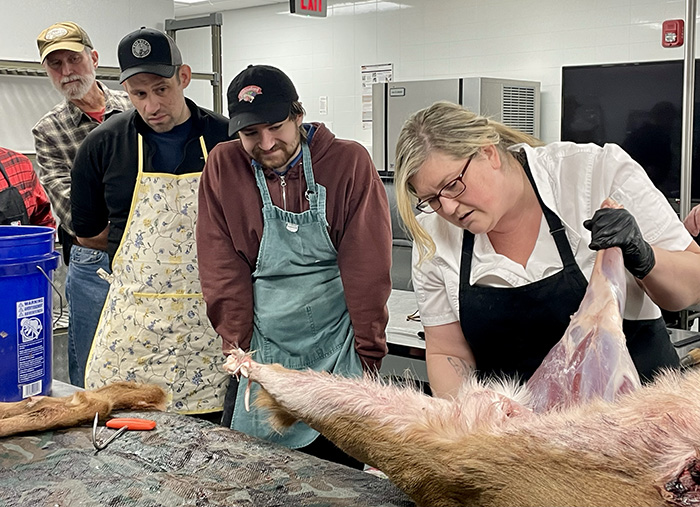
The class learned how to skin the deer, cut its carcass into workable parts, and harvest as much usable meat as possible.
The process involves much eye-hand coordination and sometimes strength .
“No one said butchering a whole deer into retail cuts was going to be fantastically easy,” Chef Peterson warned.
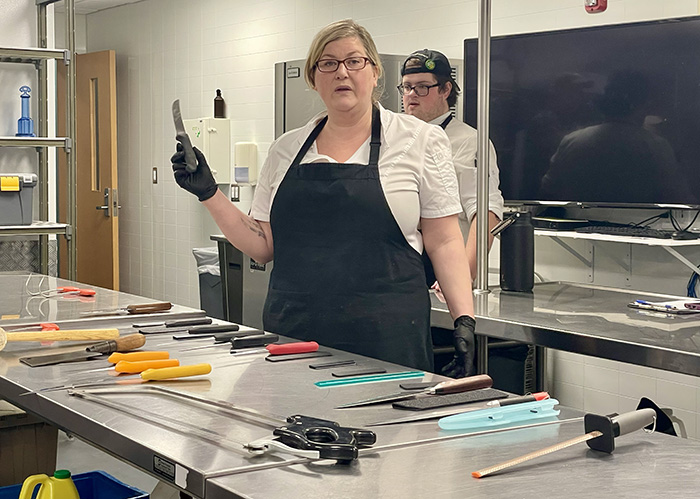
We spent more than an hour just learning knives — including a good lecture on sharpening.
By the end, each student went home with fresh meat, in about 20 different cuts, in bags or Tupperware boxes.
Chef Petersen, 46, is skilled and opinionated, with humor and raw energy, prone to mild “cussin’,” as she calls it.
Her asides alone are worth the price.
She’d told me earlier she grew up rough in Lake George, the daughter of Eastern European immigrants. She learned to make pierogi as a second grader.
Chef Petersen said, “We didn’t have much,” but that her mom used what they did have with creativity, and encouraged the same in a daughter who loved to experiment with food.
She said her natural curiosity was fed in kitchens, then area meat shops, working her way up, learning to process animals on area farms, at Healthy Living, at her own famous if short-lived butcher shop in Troy, cutting meats for fine dining at The Sagamore in Bolton, and Salt & Char in Saratoga, among her many gigs.
Her own tools were an astounding array of butcher knives for skinning, cutting through joints, paring meat from sinew and bone, and cleaving chops.
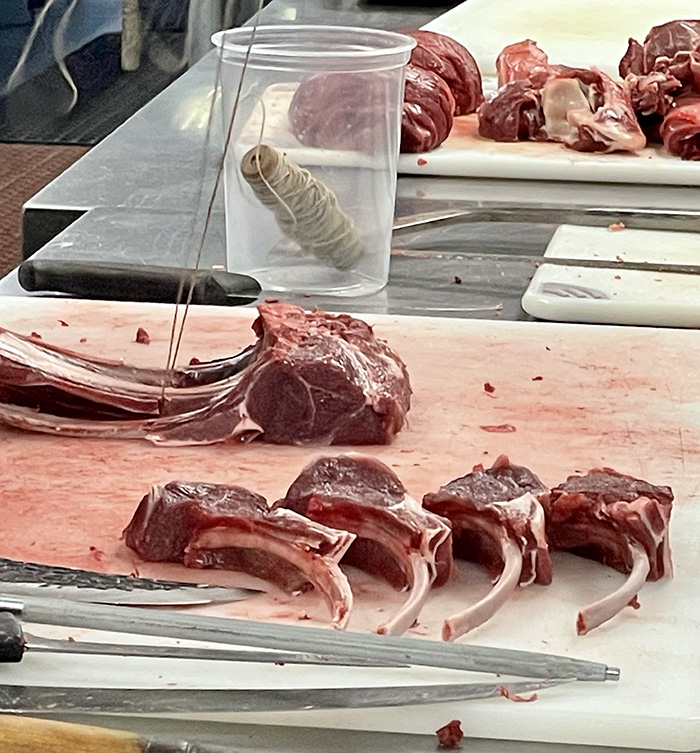
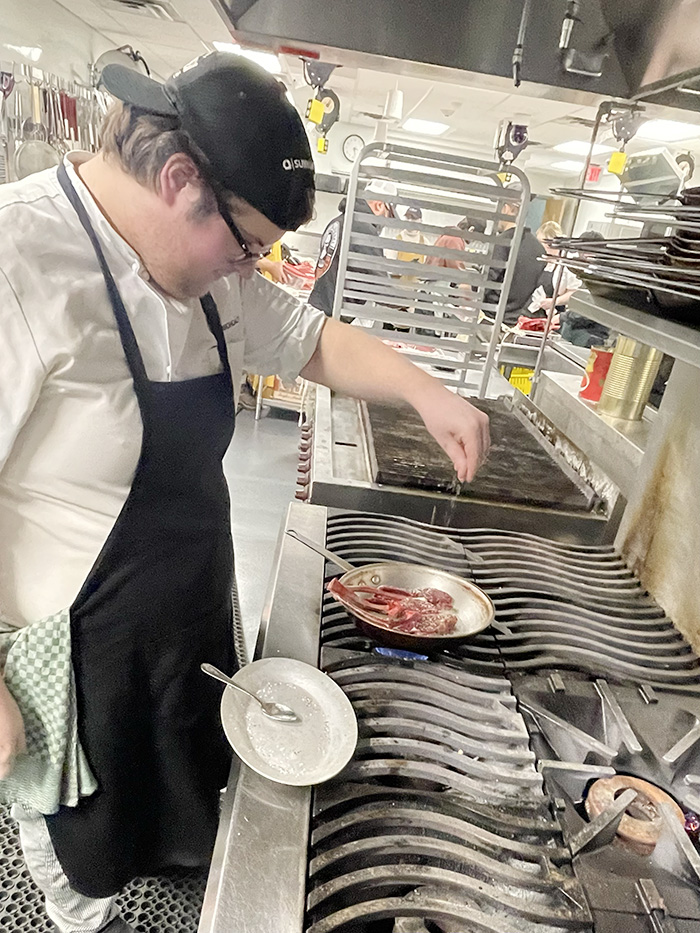
Late in class, she and students used a mallet and cleaver, then twine and fine knives to shape ribs into fancy “Frenched” venison “lollies.”
She also used also a hand saw with a food-grade blade. And a sharp eye, steady hand, and sometimes raw strength.
The chef’s messages were many — on sustainability, for example: The value of being a good shot, to both minimize an animal’s suffering, and get a better yield.
“Tell your friends to elevate their game,” she urged.
“You could just pull the backstraps and put the rest in ‘grind,’” Chef Petersen repeated — short for typical fast venison processing that saves only the couple of best cuts and grinds the remainder for sausage or chopped meat.
She advocates, instead: With some time, work and skill, it is possible to get several “beautiful” roasts, steaks and other cuts from the deer.
She said grocers typically get their meats “boxed,” from wholesalers, only the popular cuts, with minimal work to be done by behind-counter staff.
“You all have had more opportunity now to take apart a whole animal than your average counter worker in the 518,” the chef told the class.
“It’s unfortunate that Americans have filed down our food options where meat is concerned to five cuts. Everything else is grind or roast. We just don’t know what to do with it. You’re not going to find anyone doing whole animal around here.”
She listed a few butchers who opened a shop as she did, “but it’s not sustainable.”
“What makes this so special is no one’s doing what you’re doing right now,” Chef Petersen told her 12 students. “I can show you 100 meat shop workers in this county that have never done this before.”
Resources: Chef Petersen recommends Butchering, an illustrated guide by Adam Danforth out of SUNY Cobleskill, working with Doug Stratton of Stratton Custom Meats mobile slaughter in Hoosick Falls.
Copyright © 2025 Lone Oak Publishing Co., Inc. All Rights Reserved