 Glens Falls Chronicle Serving the Glens Falls/Lake George region; Warren, Washington and northern Saratoga counties since 1980

CEO: We prep mill for next 30 years
By Mark Frost, Chronicle Editor
Finch Paper CEO Drew Gardner told The Chronicle Tuesday, “We don’t run this mill like other mills in the uncoated free sheet space that are just trying to run for another five years before they shut down. That’s not at all what we were doing.
“We are setting this mill up to run not five years, not 10 years, but 30 years or more. That’s our operating horizon and that’s how we make our decisions.”
He said making their own pulp is no longer viable.
He cited “some dynamics that are happening across all of North America, not just unique to us. But a lot of these smaller integrated pulp mills, like what we have at Finch, really have two challenges.
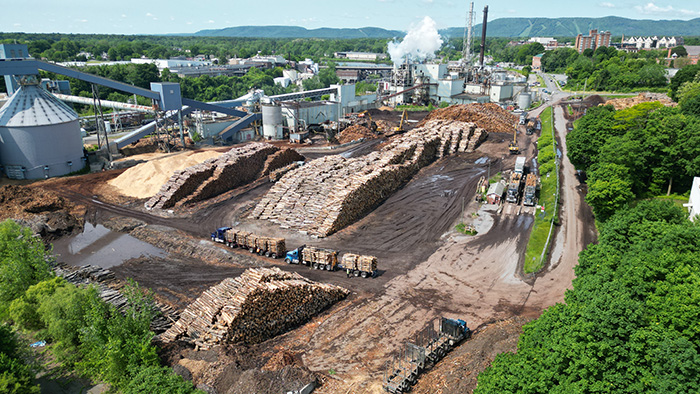
Note the loaded log trucks and the woodyard piled with logs, with the papermill beyond. This will end as Finch Paper buys all its pulp instead of making it. Photo by Spencer Bray
“The second dynamic is, those pulp mill assets are simply getting older and older, which means there’s a tremendous amount of capital needs to keep those assets operational….You’re investing in those pulp mills, not to make them better, you’re just investing in them to keep them running. You’re not getting any sort of efficiency or productivity benefits out of those investments.
“And as those dollars to keep those pulp mills have gotten greater and greater with inflation, that directly pulls from money that we need to be investing in paper making.”
At the same time, he said, specialized mills just making pulp gained strength.
“Some of these mills are enormous and have new assets and automation that we just can’t compete with,” Mr. Gardner said. “Just to put it in perspective, some of these newer pulp mills can manufacture what we make in a year in three weeks….It’s just an entirely different scale…
“And so, with that network of pulp mills in the U.S., Canada, around the world, we’re able to purchase pulp from them at better cost than we can manufacture it internally.”
He said it also enables Finch to buy different pulps that enable it to expand its product line.
Mr. Gardner said, “We have full order books. Our customers love our products. We have a best-in-class quality platform for what we do. But again, in order to do this, to stay competitive, we have to continuously reinvent ourselves….”
The CEO said, “What we do here, no other mill can do in the uncoated free sheet space. It is really technical and really challenging to do what we do. To do on the order of 15 grade changes in a day across a machine room is very, very challenging. So we are set up to do that with the team that we have and the assets that we have.
“But this move is going to go a long way in furthering that strategy and increasing our resilience, because we’re not going to be deploying a bunch of capital where we’re not really getting a ton of value-add out of those dollars. We’re going to be deploying capital where it really counts, which is around paper making.”
Finch CEO: All hourly workers will keep jobs
Finch Paper CEO Drew Gardner, when asked his message to employees, said, “Our message to employees is that this is a great strategic decision that sets Finch up for the long term.”
He emphasized that all hourly workers will retain employment.
“The hourly workforce, these are Finch employees that have worked for us for a long, long time. They have a ton of knowledge and a ton of experience. We need to retain those people and that’s what we’re fully focused on first and foremost.”
The initial press release also said, “Similarly, many of the affected salaried employees will also have the opportunity to be considered for open positions.” — Mark Frost
Pulp friction
By Mark Frost, Chronicle Editor
Finch Paper’s announcement Friday that it will stop making its own pulp — and stop buying from the independent loggers who have supplied the Glens Falls papermaker for 161 years — sent shock waves locally and throughout the Northeast.
The President of the Vermont Forest Products Association, Steve Hardy, called it a “devastating gut punch…For generations, Finch has been one of the largest buyers of low-grade wood in our region, taking the crooked, diseased, and otherwise unmarketable logs that come out of every well-run timber harvest.
“When a buyer that size steps back, the ripple effects reach every log landing in our state. Finch’s move is not an isolated event. It joins a growing list of resource-processing capacity leaving our region. Each had its own reasons, but together they point to the Northeast having become too costly and uncertain a place for resource-based processors to reinvest in. That should be a four-alarm fire for anyone who cares about Vermont’s working landscape…”
New York’s working landscape, too.
Late in The Chronicle’s exclusive interview Tuesday with Finch Paper CEO Drew Gardner, spokesman Mark Behan said, “I just wanted to add…that we began the day today with a long conference call with the EDC Warren County…We’re working with them to try to develop new markets for the wood suppliers and they’re actively engaged in working with the Empire State Development Corporation and ESFPA, the Empire State Forest Products Association, to provide whatever technical assistance that Finch can provide along with the EDC leadership to identify wood markets for those wood suppliers.”
The late legendary Finch, Pruyn CEO Dick Carota told me more than once that the independent loggers are Finch’s unsung heroes, making enormous investments in equipment, doing grueling, risky work, taking the leap, being the ultimate entrepreneurs.
But as in so many other realms the way of life is straining. As older loggers have retired, “their kids don’t always want to go into the same profession,” Debabrata “Deba” Mukherjee, Mr. Gardner’s predecessor as Finch Paper CEO, told The Chronicle last year.
Mr. Mukherjee said that to encourage more people to pursue logging, “we have been talking to Paul Smith’s College” and seeking help from “EDC, maybe some equipment financing, because logging is a heavy equipment type of profession we need to reinvigorate.”
One wonders if New York State even cares. Papermaking is heavy industry, there’s pollution, there’s smell, there’s noise. Those jobs get ushered overseas.
The mill has its detractors locally.
“So will Glens Falls stop smelling like bad eggs and hot dogs at all times?” someone commented on our Facebook page reacting to our post Friday headlined, “Finch Paper Will Stop Making Its Own Pulp.”
I asked Mr. Gardner about the topic Tuesday. Ending its own pulp-making “will positively impact our odor,” he replied. “It’s going to be a lot less smelly.”
I’ve always been willing to live with the smell for the sake of the jobs and the community’s prosperity, but more than a few people wish Finch Paper would close. Two prominent developers separately told me years ago “it’s the best thing that could happen to Glens Falls.”
In 2007, Atlas Holdings and Blue Wolf Capital bought the Finch Pruyn papermill — which had been locally owned for 142 years — and renamed it Finch Paper LLC. Almost immediately they sold Finch’s vast Adirondack land holdings, 161,000 acres, to The Nature Conservancy, much of it now added to the state’s ‘Forever Wild’ Forest Preserve.
Finch retained a right for 20 years to harvest wood on some of the lands. The 20 years ends next year. Some speculate that’s part of why the company made the decision now to stop making pulp, but current CEO Mr. Gardner flatly refutes it.
“The portion of wood that we got from that long-term fiber supply agreement is not a significant portion of our overall pulp wood buy,” he told me Tuesday. “This decision’s totally disconnected from that. It’s more a function of just the challenges associated with getting our hands on the amount of wood that we need and the cost of that wood.”
I wondered initially if Atlas Holdings was sincerely committed to the mill. I think they have been and are.
I consider Glens Falls incredibly lucky still to have this industry and the other rare surviving industries that actually make stuff.
I recoil when people say they want Glens Falls “to be like Saratoga.” I like that Glens Falls remains a place where people who may not have a college degree can get industrial union jobs that pay well and offer careers. When I bought my initial house on Sierra Street, my next-door neighbor worked for Finch. Proud of it.
Blue collar people are not in high esteem anymore, but not everyone wants to live via keyboard and screen.
When Glens Falls High School was mulling alternatives after it ditched Indians as their mascot, I suggested The Pulpers. It didn’t gain any traction — I didn’t expect it would — but I liked that it referenced the cornerstone this city was built upon.
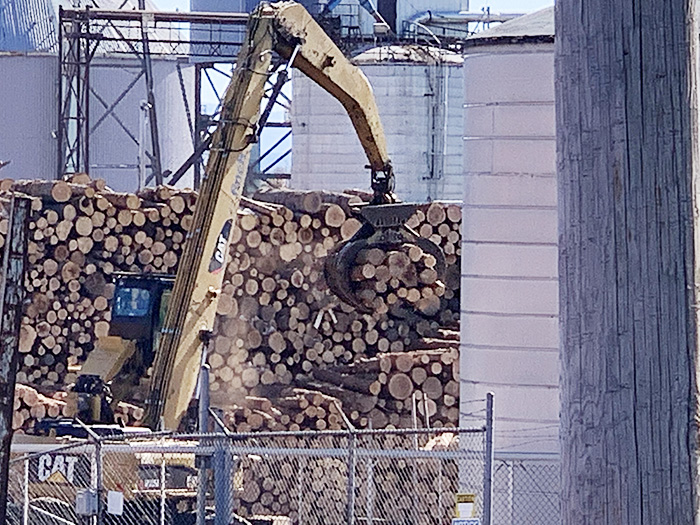
Every visitor who comes to town I take to see the logs piled high at the Finch woodyard. I’ve considered the log trucks that arrive at all hours at the mill the symbol of Glens Falls. I appreciate that a security guard at the Hyde Museum told me that when a visitor remarked that she loved the museum but that “it’s too bad what’s right behind it,” he wanted me to know that he told her, “What’s behind it is why this museum is here.”
Everything is changing and faster all the time. Still looking to keep Glens Falls Glens Falls. It’s a challenge.
Copyright © 2026 Lone Oak Publishing Co., Inc. All Rights Reserve

