 Glens Falls Chronicle Serving the Glens Falls/Lake George region; Warren, Washington and northern Saratoga counties since 1980

By Mark Frost, Chronicle Editor
Noah Chirnomas, 22, just graduated from Muhlenberg College in Pennsylvania with a B.A. in Accounting and Finance. He’s on his way to becoming a Certified Public Accountant.
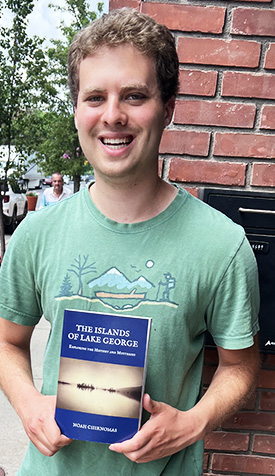
First he wrote Dome Island: Forever Wild on Lake George.
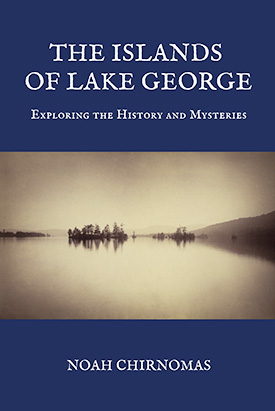
This week brings release of his new book The Islands of Lake George: Exploring The History and Mysteries. It’s a mighty piece of work, 340 pages, more than 350 historic photographs, ambitious narrative to go with it. It’s softcover, priced at $29.95.
My prediction? Big hit. Must-have for Lake George ardents.
Noah, besides researching and writing, is his own publisher. He has the stores lined up to sell the book. He’s got gigs booked to talk about, sell and sign his book in July and August, starting July 14 at the Bolton Free Library at 6:30 p.m.
Chronicle readers already have some familiarity with the book, through weekly excerpts we’ve been running in recent months. There’s another on page 30 of this Chronicle about “Dr. Bloodgood’s bungalow” that stood on what is now Hens & Chickens Islands.
Q&A with author Noah Chirnomas on LG islands book
Chronicle editor Mark Frost writes: I posed a series of questions to Noah Chirnomas. Here’s our e-mail exchange.
Why did you decide to do this book?
As a young boy, I loved spending time on Lake George with my family. I was always curious about the history of the lake’s islands. I remember looking over a map when I was eight years old, eagerly learning the name of every island. I wondered how they got those names.
Dome Island was always my favorite with its unique, near perfect dome-shape. I began reading and researching and I came to learn of one man whose hard work and dedication helped to save Dome Island from development and establish it as a nature preserve.
That inspired me to write my first book Dome Island: Forever Wild on Lake George. Learning of Dome Island’s story piqued my interest in finding out what stories existed about the other islands.
I ended up researching all 125 named islands on state maps and tried to find as many historic photographs as possible to bring the history and stories of these islands to life.
How long did it take you to research and write it? I began researching in 2023, and it took a little over three years to finish this new book.
How did you research it? Trying to piece together the history of the islands led me on a large scavenger hunt. I spent days poring through old photos and documents in the archive rooms of libraries, museums, and local historical societies, as well as looking through private collections. I’m grateful to all of the people who were willing to help me by sharing photos and information during my research journey.
What’s your favorite discovery or thing you’ve learned? My favorite gem was finding an 1868 newspaper article that had a vivid, first-hand account of the near catastrophic event that led to the naming of Refuge Island.
Growing up, I was familiar with this story, which had been passed down through the years ever since Seneca Ray Stoddard’s first telling of it in his 1873 Lake George guidebook.
Stoddard shared that Erastus Corning Smith, owner of the nearby Fourteen Mile Island House (on Fourteen Mile Island), and his sister, Julia Smith, were among a group in a rowboat that was caught in a dangerous storm and found safety for the night on an island.
Fortunately, they survived and the island became known as Refuge Island for having provided them refuge from the storm. For me, reading that description in the 1868 newspaper article made me feel as if I was there on that boat with them caught in the storm.
I knew that people built cottages on many state-owned islands in the 1800s, but I didn’t realize just how elaborate some of these “squatters’ cabins” were until I found photographs of them during my research. Some even had two stories and a wrap-around porch. By 1919, the state had removed all of the squatters’ cabins to allow the public to camp on the islands.
What’s your favorite island? Dome Island has been my favorite ever since I was little. I do have a favorite camping island, but I’m going to keep that one a secret!
What do you hope people will take away from the book? The islands are an essential part of the lake’s scenic beauty and many provide opportunities for the public to camp and picnic. Even though people spend time on the islands and may have a favorite one, they may not know how they received their names or about the interesting people that used to spend time there and the events that took place on them. I hope that readers will gain an even greater appreciation for the islands that so many of us love.
How old are you? 22 years old.
Are you still a student at Muhlenberg College? Just graduated with a B.A. in Accounting and Finance.
What’s your career goal? Starting in public accounting in the fall. Working towards the CPA license.
What will you do this summer? Giving slideshow presentations in the region about the book to share the stories of uncovering the most interesting historical finds.
Do you have another book in mind or under way? I’m exploring some other projects to work on next relating to the history of Lake George.
Where the book is now available:
• The Book Cabin
• Chapman Museum
• Fort William Henry Sutler Shoppe
• Hague Market
• Lake George Land Conservancy
• Lake George Steamboat Co. Gift Shop
• The Silo
• Silver Bay General Store
• St. Andrews Ace Hardware
• Trees Adirondack Gifts & Books
• Warren Warren County Historical Society
Copyright © 2026 Lone Oak Publishing Co., Inc. All Rights Reserve
